France now has more campsite pitches than hotel rooms (863,000 against roughly 656,000) and demand keeps climbing even as the number of sites shrinks. For any operator or investor arriving from another market, that combination usually means one thing: capital is moving faster than the supply of genuinely well-designed sites, and the ones winning aren’t the biggest. They’re the ones that get the execution right from day one : the conception, the fit-out, the energy systems, the furniture.
A market consolidating around fewer, better sites
Since 2010, the number of campsites in France has dropped from over 8,500 to around 7,400, while annual visitor numbers climbed from 19 million to 28 million, according to Nicolas Dayot, president of the FNHPA. Four and five-star sites now capture 58% of all nights booked, and groups like Homair, Sandaya, Capfun and Siblu control just 19% of sites but 65% of sector revenue, a gap wide enough that institutional money has taken notice. European Camping Group, which owns Homair in France, counts the Abu Dhabi Investment Authority, ICG and PAI Partners among its backers, and consolidation specialists like Meridia Capital have been actively separating real estate from operations (so-called Opco/Propco deals) across French sites.
Glamping still makes up only around 10% of the French offer, but it earns three to four times the nightly rate of a standard pitch. That gap is really the whole story: capital is chasing design-led, well-run sites, not raw land.

Where the real differentiation happens ?
Two sites with an identical location and an identical star rating can produce very different revenue per pitch. The gap almost always comes down to four things: conception, fit-out, energy and furniture.
Conception – Design
Master planning a French outdoor hospitality site is a different exercise from converting a plot into rows of pitches. It means reading the terrain, working within ERP-style safety classifications, and designing a guest journey that works equally well for a couple on a weekend and a family on a two-week stay. The sites earning the strongest reviews right now are laid out around how guests actually move through their day (pool, restaurant, lodge, communal space) rather than around how many pitches fit on the plot. Tree cover and green space ratios also feed directly into a site’s star classification, which means landscaping is never purely cosmetic here; it’s part of the business case.
Fit-out
This is where a lot of foreign projects lose time they never budgeted for, and it goes well beyond the lodges themselves.
Privacy and noise are a constant design problem in outdoor hospitality, guests are living a few metres from strangers for a week at a time, so the strongest sites now stagger pitches and use planted buffers rather than fences to break sightlines and cut sound transfer between units. Accessibility is non-negotiable too : French ERP classification requires a set share of PMR-accessible units, with wider paths, adapted bathrooms and step-free access built in from the master plan rather than retrofitted later, which is far more expensive and rarely looks as good.
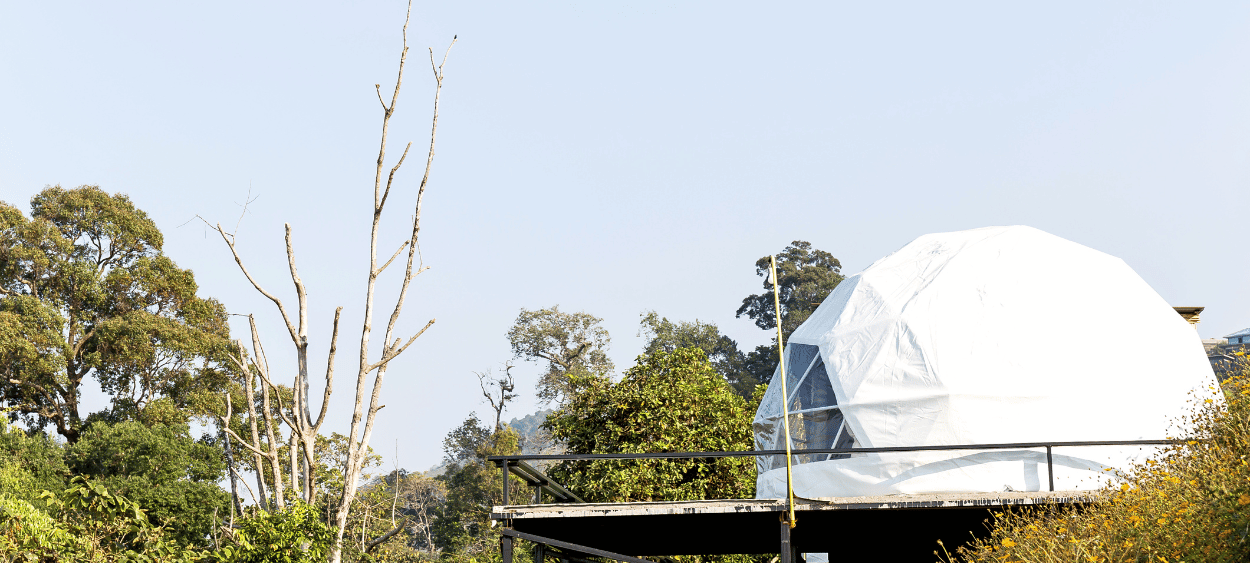
Inside the units, the shift is toward flexibility over fixed formats: lodges with movable partitions that convert from a couple’s retreat to a family unit with a single reconfiguration, communal areas that double as coworking corners for the growing share of guests working remotely mid-stay, and multi-generational layouts built for the increasing number of trips involving grandparents, parents and kids under one roof rather than the classic couple-or-family split. Construction methods are shifting too off-site modular units, built and finished in a workshop and transported to site. There are increasingly preferred over on-site construction, since French high season leaves an unforgivingly short window to build, open and start earning before the next winter closure.
Energy
Energy has moved from a back-office cost line to a design and compliance question, and the regulatory pressure is real. Under France’s 2023 renewable energy law (loi APER, article 40), outdoor parking areas above 1,500 m² (a threshold that catches the guest parking of most larger campsites) must now shade at least half of that surface, with a minimum of 35% of the shaded area generating solar power (the rest can be vegetative planting, following a 2025 amendment that allows mixed solar-and-greenery shading). Lots above 10,000 m² had to comply by July 2026; smaller lots, from 1,500 to 10,000 m², have until July 2028, with conditional extensions available for operators who commit to a supplier early. Non-compliance carries administrative fines of €20,000 to €40,000 per year, cumulative until the site complies and a deadline worth building into a project timeline from the outset rather than discovering it mid-permit.
Solar canopies over guest parking, paired with rooftop panels on sanitary blocks and reception buildings, also come with genuine upside: they offset a real share of a site’s electricity bill, and several operators report qualifying for accelerated depreciation and property-tax relief on renewable energy equipment, though the exact terms depend on the installation and are worth confirming with a tax advisor rather than assumed upfront. Canopies are increasingly built with integrated EV charging too, which matters for a growing share of European guests arriving by electric vehicle.
Beyond solar, the sites managing energy best are also the ones tackling their two biggest hidden consumers: heated pools, which are a notorious drain on a campsite’s energy budget, and sanitary blocks, both of which respond well to heat pumps instead of gas or electric resistance heating. Greywater recycling and rainwater harvesting for irrigation are becoming standard on new builds too, partly for cost, partly because several regions popular with campsites are already managing seasonal water restrictions and a site that can show water resilience has an easier time getting permitted in the first place.
The bottom line for 2026
France’s outdoor hospitality sector is smaller in site count than it was fifteen years ago and considerably bigger in almost every other measure that matters : guest numbers, revenue per site, institutional interest, international attention. The sites capturing that growth aren’t necessarily the ones with the best location. They’re the ones where conception, fit-out, energy and furniture were treated as a single decision from the start, not four separate ones made under deadline pressure.
Opening an office in France means navigating a regulatory framework that is more detailed than many international companies expect, but it is also an opportunity to design a workspace that genuinely performs. The standards exist because the French approach to employee well-being in the workplace is serious and well-developed. A company that meets those standards, and goes further in its design ambition, ends up with an office that attracts talent and supports productivity over the long term. That is the return on a well-executed fit-out.
Groupe Pagès designs and delivers open-plan office fit-outs across France, from space planning and regulatory compliance to custom furniture manufacturing and full TCE project management. Contact us to discuss your project.
Article published on 30 July 2026