Setting up an open-plan office in France is a project that brings together two very different sets of decisions. On one side, there are the legal and regulatory requirements, things you have no choice about. On the other, there is the design itself: how you layout the space, manage noise, choose materials, and create an environment where people actually want to work. Get both right and you have a workspace that works on every level. Neglect either one and you will feel it, whether through a compliance issue or through a team that struggles to focus.
What French law actually requires
French law places clear obligations on every employer regarding the physical quality of workspaces. The Labour Code (Code du travail) establishes a general duty of care: employers must actively protect the physical and mental health of their employees. For office environments, this is not an abstract principle, it translates into concrete requirements.
Air quality and ventilation are regulated under Articles R.4212 and R.4222 of the Labour Code. Any permanently occupied workspace must have sufficient air renewal, and in most open-plan offices this means a mechanical ventilation system. A double-flow VMC (ventilation mécanique contrôlée à double flux) is now the standard solution, it ensures controlled airflow while recovering thermal energy, which also helps with energy costs.
Noise exposure thresholds are set at 80 dB(A) over an eight-hour working day, at which point the employer must implement corrective measures. At 85 dB(A), hearing protection becomes mandatory. These thresholds were designed for industrial environments, however, in open-plan offices, the cognitive impact of noise becomes significant well below these levels, typically from 55 to 60 dB(A). The legal floor is a minimum, not a target.
If your office is accessible to clients or visitors, it may be classified as an ERP (Établissement Recevant du Public), triggering additional fire safety and accessibility obligations: emergency exit widths, smoke extraction, fire-rated partitions, and full accessibility for people with reduced mobility (PMR). This is worth confirming early, many companies assume their office is purely internal, and discover the ERP classification only when works are already underway.
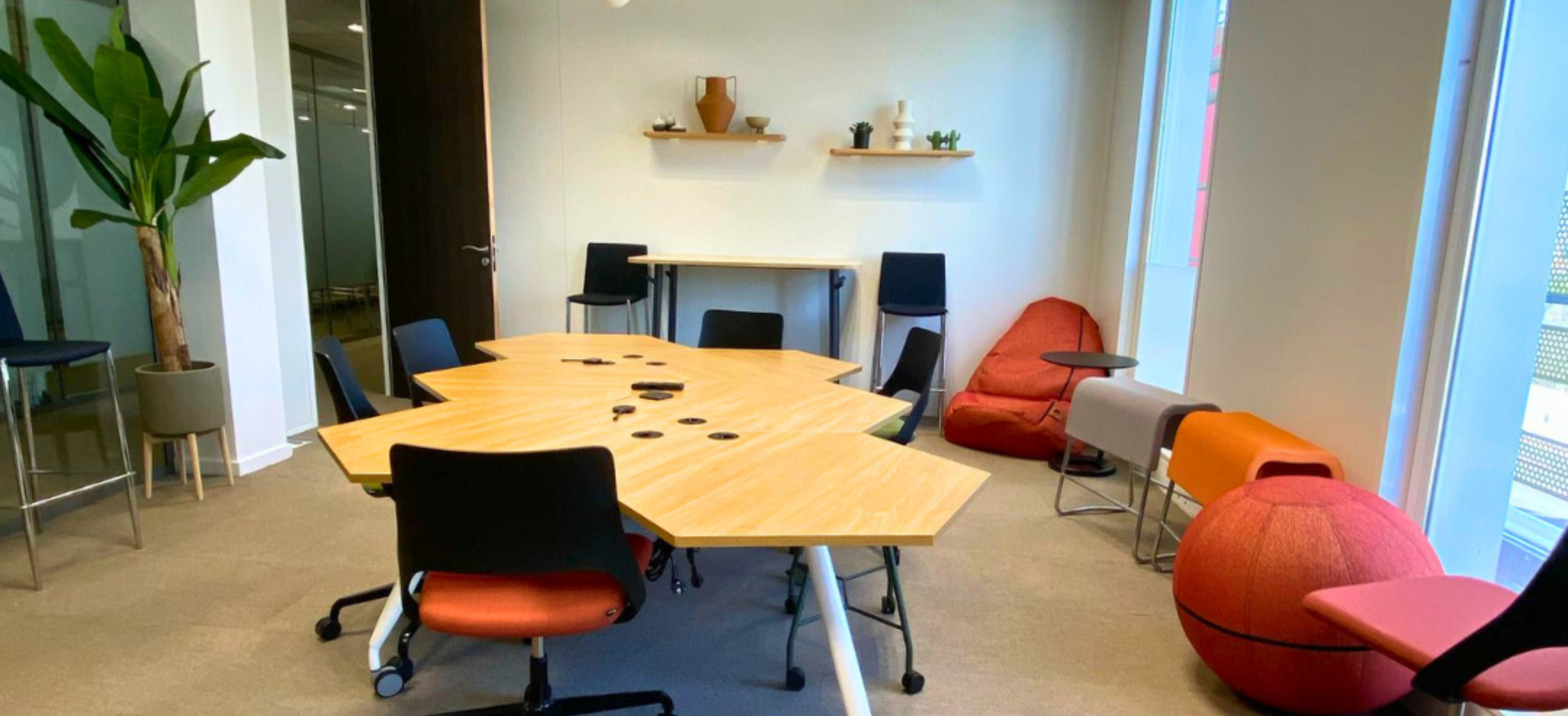
Office design project by Groupe Pagès. See all projects
The NF X 35-102 standard: a reference, not a legal obligation
One standard you will encounter frequently when researching French office design is AFNOR NF X 35-102. It recommends minimum floor areas per workstation, 11 m² per person in a standard open-plan environment, rising to 15 m² in noisier settings such as call centres, along with guidance on circulation widths, room proportions, and maximum number of workstations per open zone.
It is important to understand what this standard actually is: a voluntary standard (norme volontaire), not a legal obligation. No employer is required by law to comply with NF X 35-102. Each company is free to decide whether or not to apply its recommendations. That said, it is widely used as the reference framework by ergonomists, occupational health inspectors and labour courts when assessing workspace quality. A company that clearly falls below its thresholds will have a harder time defending itself in a dispute. Treating it as a strong recommendation rather than a box-ticking exercise is the sensible approach.
Acoustics and lighting: the two design decisions that matter most
Beyond compliance, the design choices you make in an open-plan office have a direct impact on how well people work. Acoustic comfort consistently ranks as the top source of dissatisfaction in open-plan environments. The solution is not to build walls everywhere, it is to layer acoustic treatments intelligently from the outset.
Suspended acoustic ceilings with a high absorption coefficient (class A, αw ≥ 0.9) covering at least 90% of the ceiling area make the single biggest difference to reverberation time. Beyond that, the toolkit includes acoustic wall panels and baffles for high-volume spaces, desk screens that combine absorption and mass, carpet or resilient flooring to reduce impact noise, and acoustic phone booths, standalone or built-in cabins for calls and video conferences. A rough benchmark: one booth per 10 to 15 employees. Some offices also use sound masking systems, which diffuse a low-level background noise to reduce speech intelligibility across the floor.
Lighting is the other lever that separates a good open-plan office from a great one. French regulations require a minimum of 500 lux at workstation level, that is the floor. In practice, modern office lighting design layers ambient lighting with task lighting and accent elements to create a human-scale atmosphere that does not feel like a warehouse. Glare control matters: indirect or diffuse sources reduce the screen glare that causes eye fatigue over the course of a working day. An increasing number of fit-outs in France now incorporate biodynamic lighting systems that adjust colour temperature throughout the day, supporting focus in the morning and reducing the afternoon energy dip.
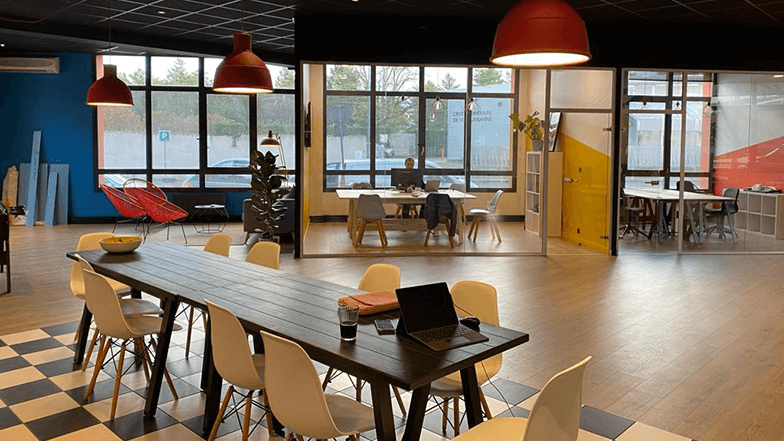
Office design project by Groupe Pagès. View more here
Zoning and layout: designing for how people actually work
Activity-based zoning is now the dominant approach to open-plan layout in France, and for good reason. Rather than assigning desks by department, the floor plate is organised around what people actually do: concentrated individual work, collaborative sessions, phone calls, informal exchanges, breaks. Each zone gets the acoustic treatment, lighting level, and furniture type appropriate to its function.
A practical zoning breakdown for most open-plan offices looks like this:
- Focus zones: individual workstations with acoustic screens, away from main circulation routes. These should represent the largest share of the floor plate.
- Collaboration zones: bench seating, modular tables, whiteboards, screens, positioned centrally or near natural gathering points.
- Call and video zones: acoustic cabins or alcoves, with ventilation, lighting, and connectivity integrated from the fit-out stage.
- Informal meeting zones: semi-open seating for stand-up meetings and quick team check-ins.
- Breakout zone: kitchen, lounge seating, informal space, at the periphery of the floor plate to avoid disturbing work zones.
Hybrid working has also reshaped how French companies calculate space. With a growing share of employees working remotely on any given day, many organisations have moved to a desk ratio below 1:1, typically 0.7 to 0.8 desks per employee. This frees up floor area for more generous collaborative and informal zones without increasing the overall footprint. It also means that locker banks and personal storage solutions need to be planned into the design from the start.
Materials, biophilic design, and the details that make the difference
Materials, finishes, and natural elements are not afterthoughts, they are part of what makes a workspace genuinely pleasant to spend time in. French office design has moved strongly towards natural materials: wood surfaces, stone or stone-effect finishes, natural textiles, exposed metal. These choices have acoustic benefits as well as aesthetic ones, and they signal a quality of environment that resonates with French employees.
Biophilic design, integrating plants, greenery, and natural references into the workspace, has become standard in new French office fit-outs above a certain level. The evidence base is solid: access to natural elements reduces stress, improves concentration, and lowers absenteeism. Green walls and planters also contribute to air quality and acoustic absorption. Where possible, workstations should be positioned to give employees sightlines to windows and natural light. Deep floor plates that push employees far from glazing are a design problem worth solving early, through light-diffusing glazing, reflective surfaces, or carefully positioned open sightlines.
Opening an office in France means navigating a regulatory framework that is more detailed than many international companies expect, but it is also an opportunity to design a workspace that genuinely performs. The standards exist because the French approach to employee well-being in the workplace is serious and well-developed. A company that meets those standards, and goes further in its design ambition, ends up with an office that attracts talent and supports productivity over the long term. That is the return on a well-executed fit-out.
Groupe Pagès designs and delivers open-plan office fit-outs across France, from space planning and regulatory compliance to custom furniture manufacturing and full TCE project management. Contact us to discuss your project.
Article published on 15 June 2026